


by Alex Daniels
Given the shortcomings of the collective action approach to the climate crisis, we at the Foundation for the Rights of Future Generations (FRFG) believe individual action should serve as a complement to institutionalised change, so that people are empowered to make sustainable lifestyle choices rather than waiting for their government to legislate for them. The focus of this post is thus not whether individuals should reduce their footprint, but whether they should make it visible. How does publishing one’s own personal carbon footprint (PerCF) contribute to societal change? Calculating one’s own PerCF but keeping it private changes very little. What may carry a larger effect is the public discussion that follows publication, because visibility itself can act as a lever for collective change, exerting a contagious normative effect that encourages the broader public to adopt similar behaviour.
When an individual shares the result of a PerCF calculation, together with the lessons learnt and actions, such as restraint, that follow from it, it can shape what Cialdini, Reno and Kallgren (1990) call an injunctive norm: the perception of what others approve or disapprove of. People align their behaviour with these injunctive norms not out of shame but because they come to see it as the right thing to do. As more individuals observe such behaviour, injunctive norms may harden into descriptive norms – what most people are understood to actually do. Their focus theory of normative conduct holds that norms only guide behaviour once they are made salient. Publicising the PerCF, then, makes environmentally conscious behaviour visible, allowing it to spread through imitation and change societal norms once it reaches a critical mass.
How large must this mass be? Experimental research by Centola et al. (2018) suggests that a committed minority of around 25 per cent of a population can be sufficient to overturn an established social convention – far below the majority that classical models once assumed necessary. Norms may shift without universal participation, provided a sufficiently visible minority of the public commits to new behavioural standards. In this sense, if a small minority of society shares their PerCF and acts on it, it might convince more people to reconsider their lifestyle choices.
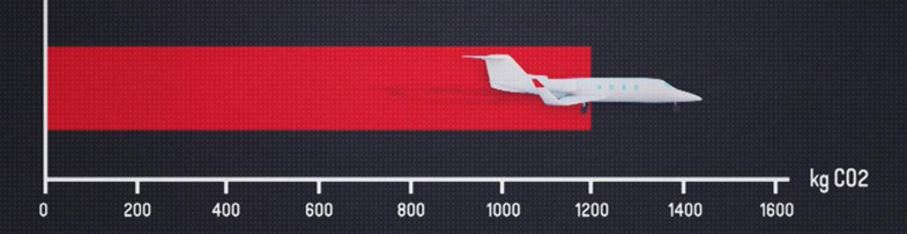
Flight shame (flygskam) in Sweden illustrates how public discussions about the PerCF can change societal norms. In 2018, a small circle of journalists and public figures began discussing the impact of their own holiday flying on their PerCF and publicly committed to flying less. What began as private conviction turned, through media coverage and everyday conversations, into a widely shared injunctive norm. Swedish domestic air travel fell for two consecutive years, and international departures dropped within a year of the campaign’s emergence. Yet the case also illustrates the limits of norm change absent political follow-through: Sweden abolished its aviation tax in 2025, restoring cheaper fares. Publicising restraint can shift behaviour, but it does not guarantee lasting policy change when it collides with the aviation industry’s economic interests. This underlines that responsibility for climate action lies with states as well as with every individual.
Besides restraint, individuals may also discuss their carbon handprint – the positive contribution their actions make to reducing emissions, whether by adopting climate-friendly technology or by helping others reduce their own emissions. What matters is reaching a net-zero lifestyle, one that adds nothing to atmospheric greenhouse gas concentrations. Bollinger and Gillingham (2012) found that each additional solar installation in a US zip code increased the probability of further adoption in the same zip code by 0.78 percentage points, an effect strongest between neighbours. A visible handprint, in other words, can normalise positive action just as visible restraint normalises reduction.
If a minority well below 50 per cent can shift a societal norm, the familiar objection that one’s own emissions are a mere “drop in the ocean” loses much of its force: a visible individual act carries a multiplier that a private one does not. This is where the argument connects to intergenerational justice specifically. If every generation is entitled to no more than its fair share of a finite carbon budget, reducing one’s own PerCF is a matter of distributive justice. Thus, making reductions visible – and thereby increasing the likelihood that others will follow – is what turns an individually marginal act into one with disproportionate weight for the generations who will inherit what remains of that budget. In this sense, by publishing one’s PerCF can trigger norm cascades that benefit future generations by encouraging environmentally friendly behaviour.
This argument invites an obvious objection: focusing on personal visibility re-individualises a structural problem, distracting from the far larger emissions embedded in corporate production and state infrastructure. As stated above, individual and collective responsibility are not mutually exclusive. The same holds here – visibility complements systemic change and can lay the foundation for it; it does not substitute for it. Another risk is performative publication, where people disclose their PerCF to appear morally superior without changing their behaviour. Yet even this form of visibility may encourage others to act. Moreover, not everyone is equally free to restrain themselves, given work or family obligations, but visibility invites people to do what is within their means.
The argument then is that individual action matters and that one cannot hide behind inertia or blame states for their failures; everyone has actions at their disposal that can make a positive contribution and even lead to wider societal change. Publicly discussing the PerCF can model behaviour that might inspire others to copy environmentally friendly actions, and, in turn, to collective action.
References
Bollinger, Bryan / Gillingham, Kenneth (2012): Peer effects in the diffusion of solar photovoltaic panels. In: Marketing Science, 31 (6), 900–912.
Centola, Damon et al. (2018): Experimental evidence for tipping points in social convention. In: Science, 360 (6393), 1116–1119.
Cialdini, Robert / Reno, Raymond / Kallgren, Carl (1990): A focus theory of normative conduct: Recycling the concept of norms to reduce littering in public places. In: Journal of Personality and Social Psychology, 58 (6), 1015–1026.