
Today is Intergenerational Fairness Day. Since we launched the day together with partner organisations in 2023, 16 November has become a moment to speak up for the interests of younger and future generations, and this year marks a milestone. In its first Strategy on Intergenerational Fairness, published in March, the European Commission committed to raising awareness around 16 November as a day marking intergenerational fairness. Today it is hosting an event at the European Committee of the Regions in Brussels, designed with the Network of Institutions for Future Generations, the UN Foundation, the ImPACT Coalition for Future Generations and the School of International Futures. It is encouraging to see an idea that began in civil society taken up at European level, and our assessment of the Strategy sets out what we make of it as a whole.
For our part, we are marking the day with an announcement of our own. At the beginning of 2027, the FRFG will launch the Transparency Club, a community of people who calculate their personal carbon footprint, publish it and work with others to reduce it year after year. The first year to be measured is 2026, the one we are living through now. Alex Daniels recently set out on this blog why such transparency matters.
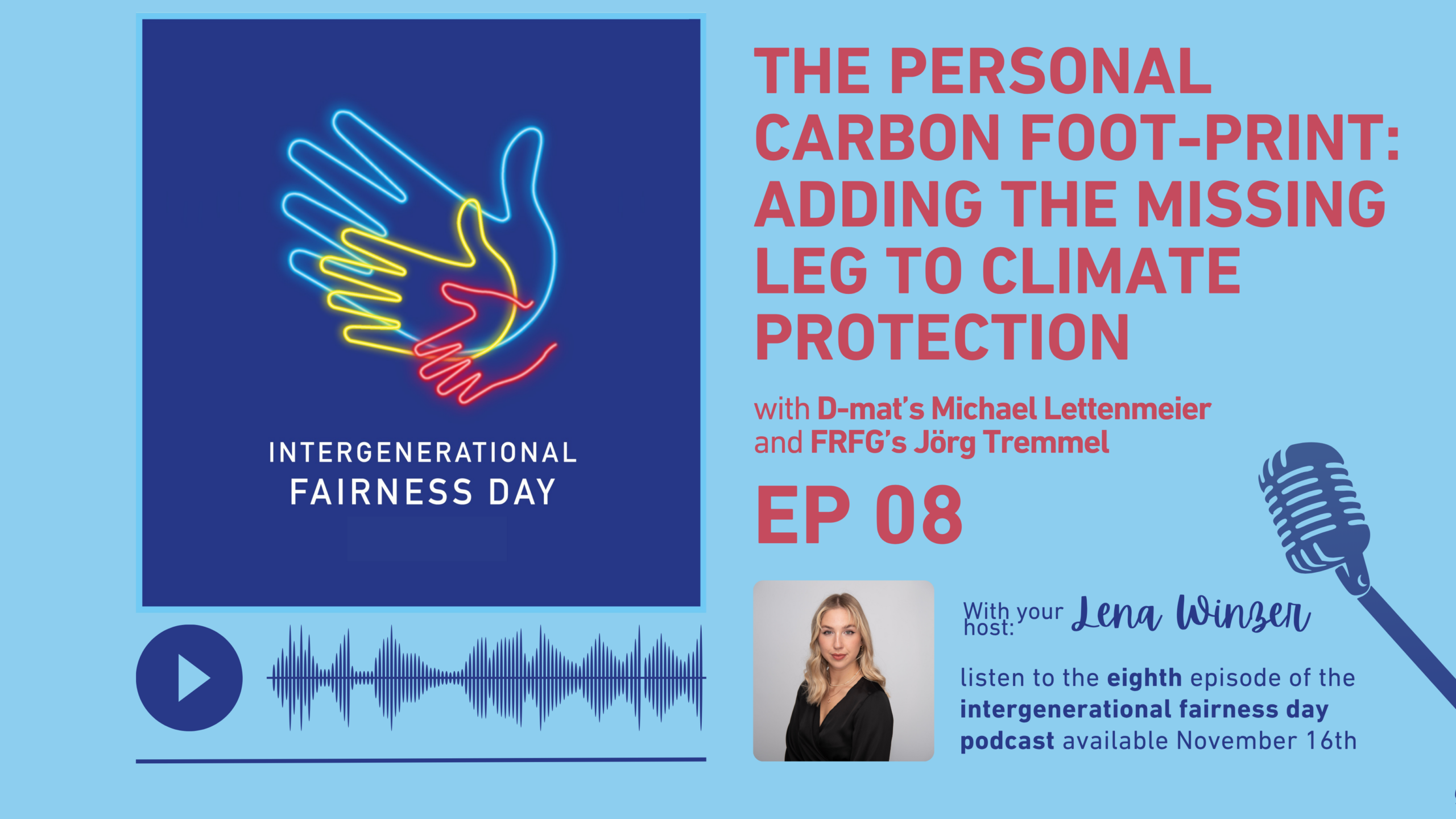
It is a project that invites an obvious objection. At a time when the climate crisis so plainly demands political answers, why ask anything of individuals? That question runs through episode 8 of the Intergenerational Fairness Day Podcast, “The Personal Carbon Footprint: Adding the Missing Leg to Climate Protection”.
Lena Winzer, the podcast’s host and a project manager at the FRFG, starts from a sceptic’s position. The familiar advice to eat less meat, fly less and switch off the lights has been repeated for decades while global emissions kept rising, and one of the first personal carbon footprint calculators was launched by an oil company. Before asking anyone else to publish their footprint, she calculated her own, and the results were puzzling. The UNFCCC Lifestyle Calculator put her 2025 footprint at around seven tonnes of CO2 equivalent. The German Environment Agency’s calculator, working from the same year and the same life, came to almost twelve.
To understand that gap, and the larger question behind it, Lena turned to two guests.
- Dr Michael Lettenmeier, founder and managing director of D-mat and co-author of the 1.5-Degree Lifestylesreports (2019 and 2021). His research produced the target against which the UNFCCC Lifestyle Calculator measures our footprints.
- Prof Dr Dr Jörg Tremmel, managing director of the FRFG and professor of political philosophy at the University of Tübingen
Michael explains how the 2.5-tonne target for 2030 was calculated, and why, almost seven years later, even that figure falls short. The conversation moves from the changes that make the greatest difference to the harder question of whether a personal number distracts from the system change the crisis requires. On the first, the car, the plane, the home and the diet far outweigh recycling or switching off the lights. The discussion also turns to fairness in a world where the richest tenth of humanity is responsible for up to half of all emissions, and to what the present owes those who come after it. One finding is hard to forget. Even under the most optimistic assumptions about technology and policy, changes to the system would deliver only a little more than half of the reductions Europeans need. The rest depends on how we live.
In the second part of the episode, Jörg sets out why the FRFG treats climate change as a question of intergenerational justice, why climate protection needs to stand on two legs, and how the Transparency Club will work. He also discloses his own footprint and explains why a high number need not be a source of shame.
Whether you already know your number or remain as unconvinced as Lena was at the start, this episode is a good place to begin.
Listen to the new episode here!
Join the Transparency Club and browse its resource hub
Calculate your own footprint with the UNFCCC Lifestyle Calculator
Read Part I of the Intergenerational Justice Review on the personal carbon footprint, with Part II following in December
Read about the winners of the Intergenerational Justice Prize on the Personal Carbon Footprint
Follow us on Instagram @intergenerationalfairnessday and use #intergenerationalfairnessday