


by Lena Winzer (FRFG Project Manager).
There are moments in European politics when you can feel the future becoming a little more tangible and long-term thinking begins to take shape in the hands of people who will actually live with its consequences. Intergenerational Fairness Day 2025 (which takes place on 16 November every year) was one of those moments. This year, the day coincided with the final and most decisive session of the European Citizens’ Panel on Intergenerational Fairness (ECP IGF), held from 14–16 November in Brussels. Over three months, 150 randomly selected citizens from all 27 Member States (one-third under 29) came together to work across generations, languages, and life experiences to answer a deceptively simple question: What should we do today to make the European Union fair for all current and future generations?
The FRFG had the chance to be on the ground, to observe the closing plenary, to speak with citizens, experts, and institutional actors (in preparation for an exciting, upcoming, new episode of the IFD Podcast), and to witness the adoption of the panel’s final recommendations – a set of 24 proposals that may strongly shape the EU’s first-ever Strategy on Intergenerational Fairness, expected in Spring 2026. Unlike previous panels with very broad remits, this one had a concrete policy destination from the start. That clarity mattered. Citizens were not drafting ideas into a void. Instead, they were co-creating a political document that the Commission has committed to using. In this light, the call to rebalance representation across generations seeks to anchor long-term thinking within political decision-making so that the needs of the present do not overshadow the life chances of the future. Citizens will also return at a later stage to assess how their proposals have been taken up, which marks a rare and meaningful moment of democratic feedback at the EU level.
A Panel with a Clear Purpose
The ECP IGF is part of the Commission’s promise to institutionalise citizen participation following the Conference on the Future of Europe. It was launched to support the preparation of the EU Strategy on Intergenerational Fairness, a major initiative under EU Commissioner for Intergenerational Fairness, Youth, Culture, and Sport, Glenn Micallef (pictured below, centre).
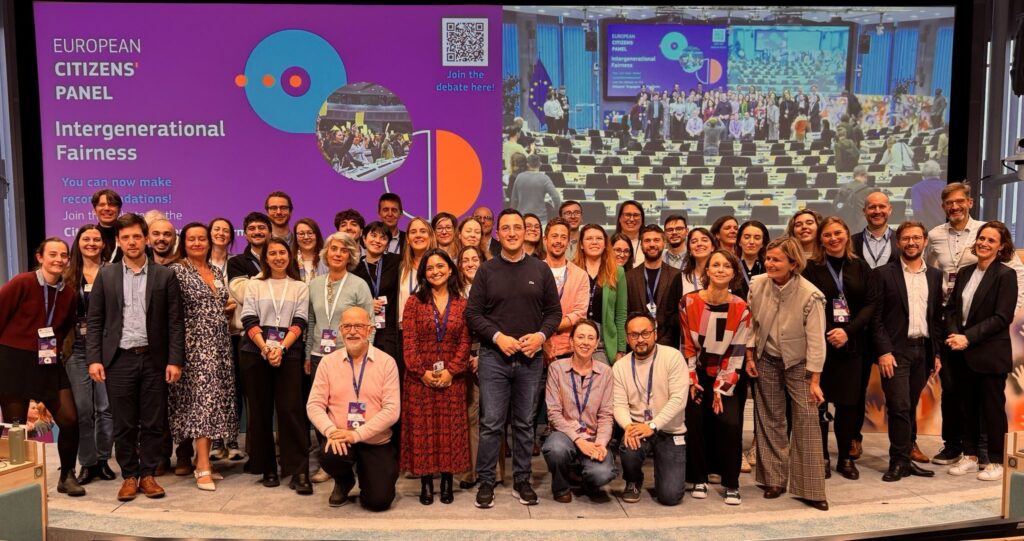
Over the course of three weekend sessions (in September, October and November), the citizens moved through a deliberately structured process to build their understanding and sharpen their collective vision. The first session, held in Brussels in September, focused on foundations: What does intergenerational fairness mean? Which issues matter most? Which visions of the future guide us? The second session in October, held online, shifted to drafting: citizens worked in twelve thematic groups and discussed three transversal questions on moral responsibility, long-term thinking, and the relationship between generations. By the time they returned to Brussels in mid-November for the final session, the task was to refine, merge, and finalise the recommendations, and to agree on the collective “Why/What” statement that frames the entire set. This final weekend marked the point at which months of learning, debate, and negotiation crystallised into the document that will now inform the upcoming Strategy.
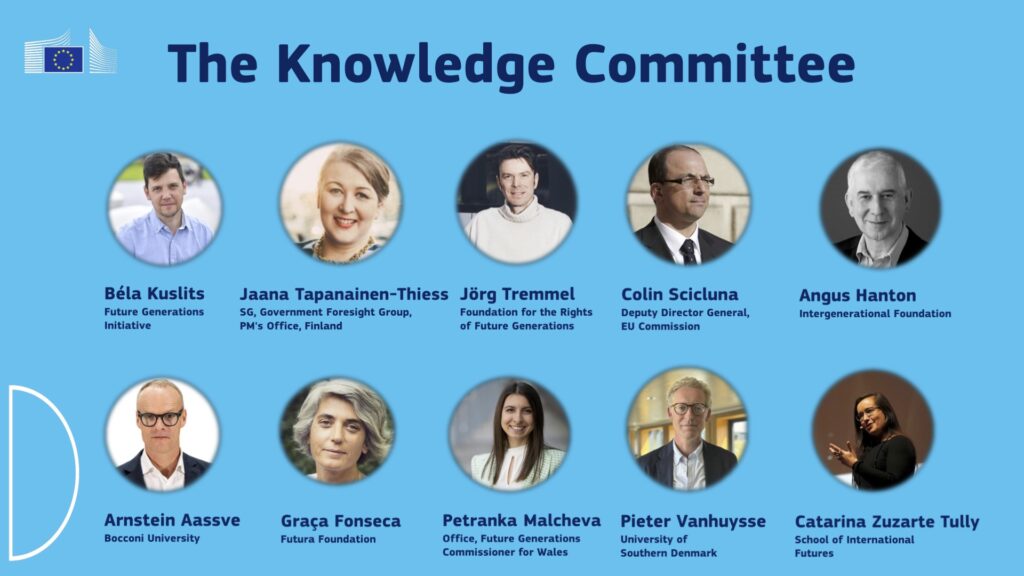
The structure itself is impressive: simultaneous interpretation in over 20 languages, expert support through the Knowledge Committee, fact-checking by the Knowledge Information Centre, and professional facilitation to ensure fairness, order, and inclusion. But what stood out most was not the machinery but the atmosphere. In the final plenary, as citizens applauded the adoption of their recommendations, you could feel that something significant had shifted. These weren’t passive participants. Many had spent evenings reading, researching, questioning experts, and debating late into the breaks. They had become, quite genuinely, co-architects of a long-term European vision.
What did the Panel achieve and where could it fall short?
The citizens ultimately produced a set of 24 recommendations that together form a coherent long-term vision for a fairer Europe, ranging from lifelong learning and social protection to environmental accountability and responsible innovation. Among these, one stands out as particularly significant from the perspective of the FRFG: the recommendation to improve and balance representation across generations. This proposal sits at the heart of the panel’s wider cluster on better governance and democratic participation, reflecting a shared concern that current political systems are too anchored in short-term incentives and do not sufficiently account for the interests of younger and future generations. The corresponding recommendation formulates this clearly: “Ensure systematic consideration of future generations‘ interests. […] Establish an independent EU-level council dedicated to representing these interests in policymaking („Council for Intergenerational Fairness“). […] The council should consist of two components: (1) an expert body, composed of specialists in intergenerational fairness to ensure a fact-based debate; and (2) a citizens‘ body, made up of randomly selected individuals to bring everyday-life perspectives and provide broader acceptance and legitimacy.”
While the atmosphere in Brussels during the final session lent itself to optimism, close observation also revealed the structural tensions inherent in the ECP format. Above all, the panels themselves remain politically rather than institutionally anchored, with their long-term influence dependent on future Commissions choosing to uphold them rather than on any formalised status. Some also pointed to the reality that Intergenerational Fairness is already constitutionally protected in 15 Member States, arguing that the EU must build on this foundation. The urgency of this work cannot be overstated. The EU Treaty’s Article 3 commits Member States to “solidarity between generations,” but until now, this has been more normative than operational. Today, the challenges confronting Europe, from climate impacts to public debt, demographic shifts, AI disruption, and housing crises, all share a common thread: They are questions of who benefits now and who pays later. Europe has positioned itself as a global leader in translating long-term vision into governance practice. But success will depend on one thing above all. Whether the EU can embed long-term thinking into the machinery of decision-making itself. As political economist Jean-Claude Juncker famously put it: “We all know what to do. We just don’t know how to get re-elected after we’ve done it.” The 2026 Strategy must address that political paradox directly.
A Personal Reflection on Intergenerational Fairness Day
Being in Brussels for Intergenerational Fairness Day, inside the room where these recommendations were finalised, felt like a glimpse of a Europe that is still emerging. A Europe in which long-term thinking is seen not as a luxury, but as a democratic responsibility. There were moments of real emotion: citizens standing to applaud each other for work they never imagined they would be capable of producing; facilitators visibly moved by the collective commitment; young participants speaking with disarming clarity about the future they hope Europe will still be capable of delivering.
This panel did not fix Europe’s intergenerational challenges – no three-weekend format could. But it did something more subtle and perhaps more important: It showed what happens when you give ordinary people the time, space, and respect to think about the long term together. For the FRFG, which has advocated for intergenerational justice for decades, this moment was a reminder that change is rarely sudden but often accumulates through processes like this, where citizens find their voice, institutions listen, and the political culture shifts, even slightly, toward responsibility and care across generations. The recommendations now move to the Commission. The strategy will follow in 2026. The real test will be whether Europe can turn this momentum into something lasting. But if the energy in Brussels on Intergenerational Fairness Day is any indication, then citizens have already done their part. The baton now passes to the institutions. And as Deša Srsen from the Cabinet of the Commissioner told me that weekend – a sentence that has stayed with me since: “Keep challenging us, because this is how Europe gets better.”
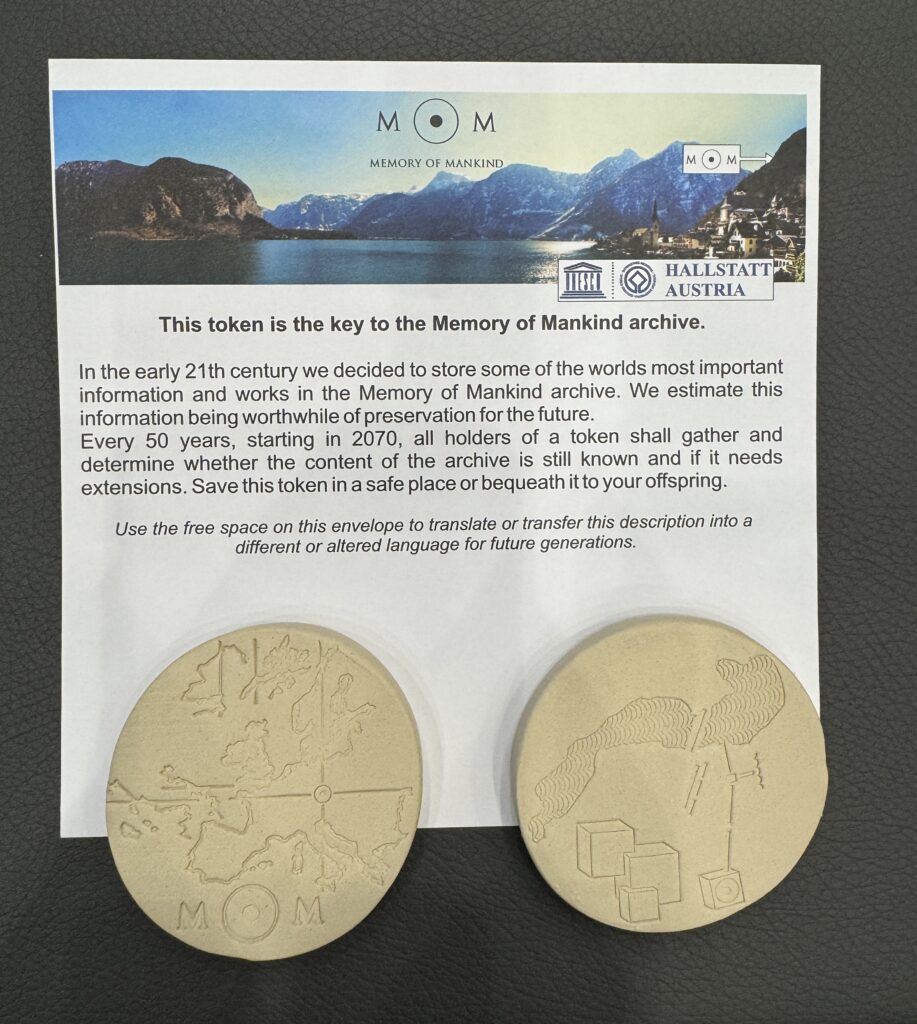
The 24 recommendations were formally transferred to the Memory of Mankind archive.